It is universally accepted that species correspond to objective natural groups of organisms. Higher taxa such as families are presumed to be somewhat arbitrary human-made constructs.
The usual requirement for higher taxa is their monophyly. Questions frequently
arise about the rank of a certain monophyletic group, i.e.
whether a certain taxon is a family, subfamily or a tribe. In general, there is no good answer to
such a question, except that it seems logical that the ranks of higher taxa should be internally consistent, i.e. evolutionary divergence, frequently measured in terms of nucleotide substitutions per site,
is about the same between taxa of equivalent rank in a certain group of
organisms. Visual grasp of this divergence can be obtained from a phylogenetic tree drawn to scale.
A tree built by a distance-based method BioNJ from the alignment of
concatenated partial sequences of EF1,
COI,
WG genes used in Wahlberg et al. (2005) adopts an interesting butterfly-like form:
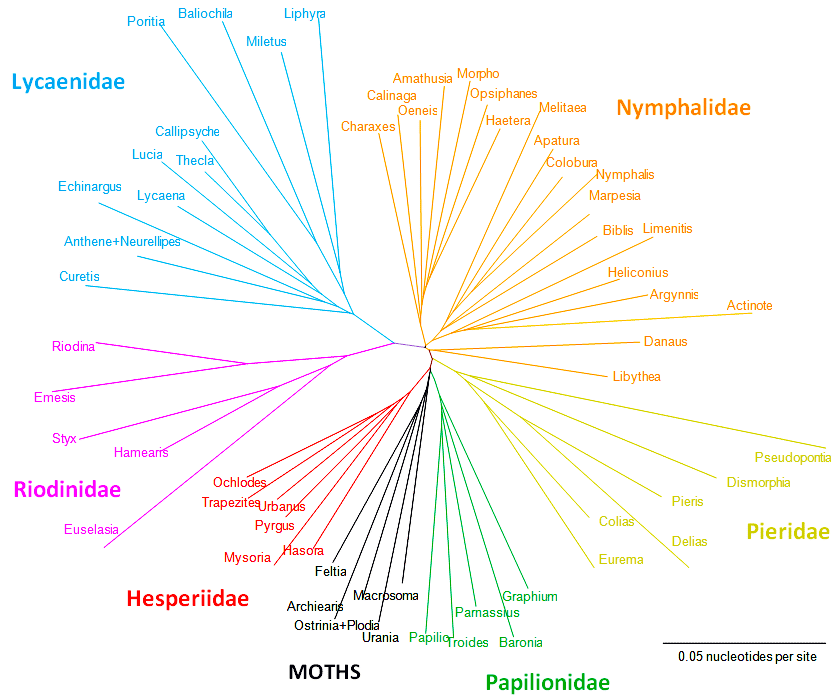
While some short branches are not reliable and attention should not be paid to minutiae of
exact branching order, it is apparent that larger groups of Lepidoptera stand out very nicely.
"Antennae" of this Butterfly of Leps are formed by Lycaenidae (blue) and Rioidinidae (magenta), "abdomen" is Pieridae (olive),
right "wings" are composed of Nymphalidae (orange) and left "wings" encompass
Hesperiidae (red), all MOTHS (black) and Papilionidae (green). Interestingly, divergence within moths is not very large, so they barely form a posterior part of the "forewing" in this Butterfly of Leps.
The most striking feature is the "antennae". It is apparent that evolutionary divergence (=distance between the tips of "antennae")
between Riodinidae and Lycaenidae is very large, larger than that between Hesperiidae and Papilionidae. This is one of the arguments used to justify the ranks of Rios and
Lycs as separate families.
On the other hand, both right "wings" represent one family – Nymphalidae. It is clear that the right "forewing", composed of the "Satyrinae" clade is separated from other Nymphalidae no less than
Papilionidae (left "hindwing") are separated from moths.
This website is supported by Butterflies of America Foundation, a U.S. registered 501(c)(3) tax-deductible nonprofit 170(b)(1)(A)(vi) public charity.


