
|


       |
Loading
|
|
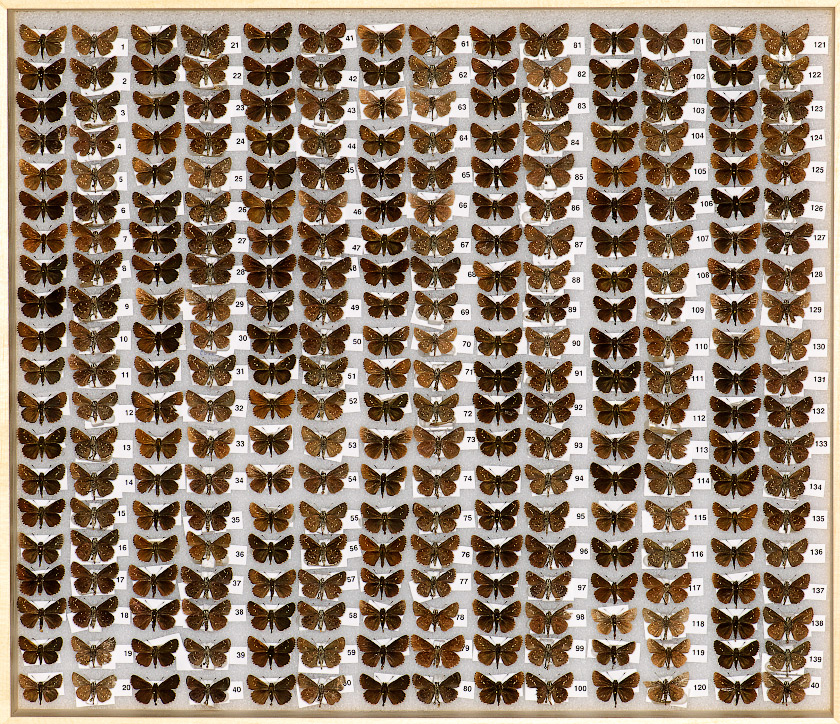
This drawer with 280 Amblyscirtes specimens from Texas and Oklahoma was shown at the annual Texas A&M University Insect Collection meeting on January 8th, 2011. Since it is very hard to identify these 2 species by either ventral or dorsal view only, each entry is composed of 2 specimens. Correctly identified specimens of two Amblyscirtes (Roadside-Skipper) species: celia (Celia) and belli (Bell's) were paired according to similarity in appearance. Special care was taken to include specimens that are particularly difficult to identify. Each entry consists of a specimen on the left displaying dorsal view and specimen on the right showing ventral view. Ventral-up mounted specimen carries the number of the entry. There are 20 entries per column and 7 columns of 2 specimens in each. The entries are arranged in random order by species and by sex. And yes, pseudo-random number generator was actually used! Can you put a name and sex on each entry?
At the meeting, the CeBellia-winner got 98% correct. Only 3 entries out of 140 were called a wrong name, and these were not the most difficult ones. And no, it was not allowed to open the drawer, just the views of the specimens as imaged below were used. These were most remarkable results, showing that it is indeed possible to separate the two species by external appearance. Can you do better? Check it out!
This small image is an overview of the drawer. The large image below is a magnified view of the same drawer, so that each specimen can be inspected in detail.
All images are © Nick V. Grishin
Download the score sheet: Microsoft Excel File
The image below is quite large: 4,980 KB, 4863 × 4136px and is not practical for dial-up, sorry.
Apologies for mediocre image quality, as it was assembled from 12 photographs, and then J-pegged in an attempt to reduce size. However, this
quality is sufficient to
make determinations. Scroll down and up, right and left to see the drawer. Print out the score sheet that you downloaded from the link shown above, or from
here.
Mark your choice for each of 140 pairs of specimens
shown below. You can use "M" for male and "F" for female to also test how you
can tell the sexes apart.
| CeBelliaTest, large image |
All images are © Nick V. Grishin
